Brachistochrone Curve
Skills: Fusion360, Digital Fabrication, Calculus of Variations, Arduino
Build Instructions: https://www.instructables.com/The-Brachistochrone-Curve/
Project Overview
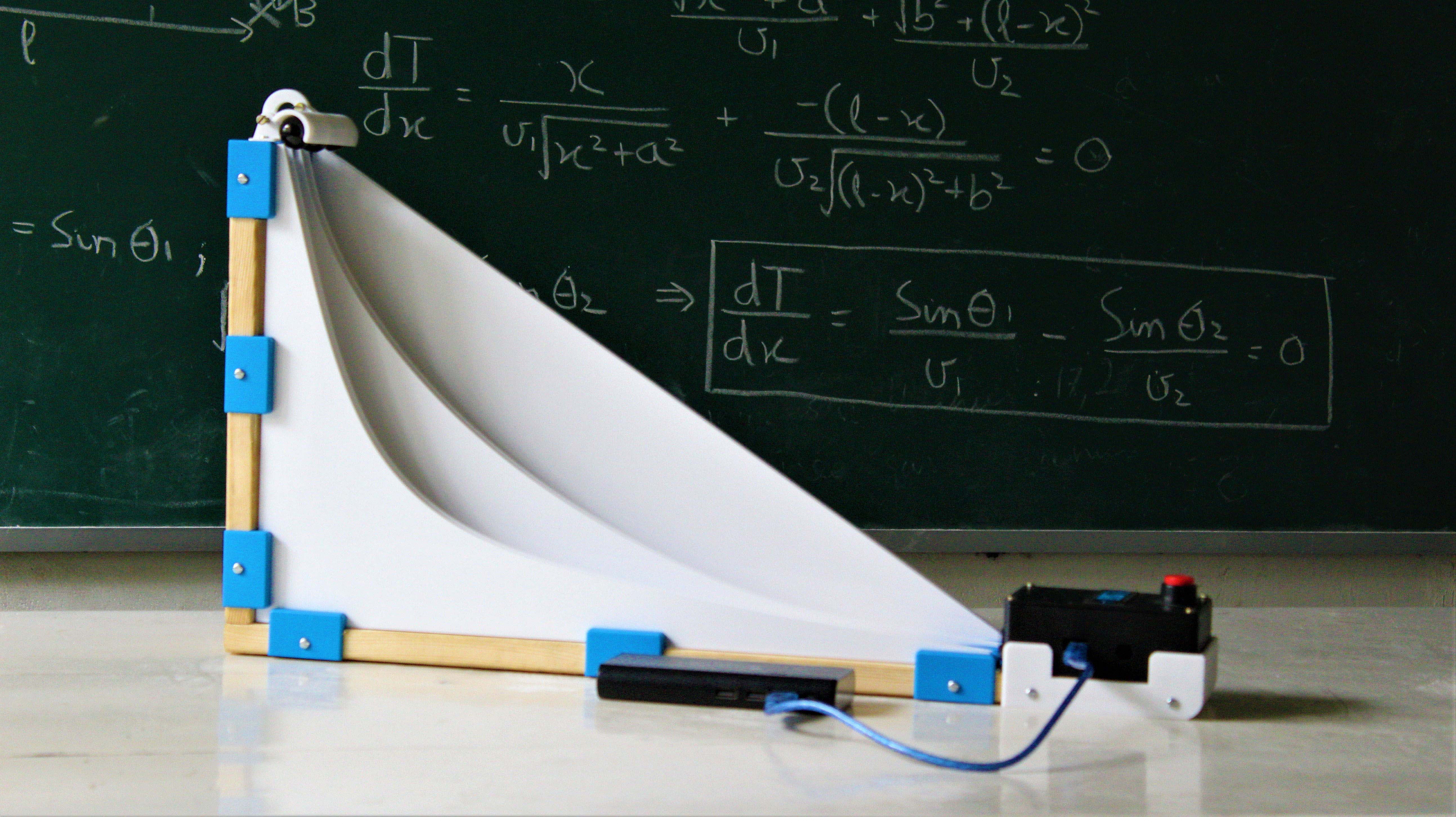
We were fascinated by the brachistochrone curve from the day that we were introduced to the concept during one of our calculus classes. The goal of this project was to make an apparatus to visually demonstrate the phenomena of fastest descent so that it could be used during physics or maths classes for younger students. The pieces were designed in CAD since precision was key and fabricated using a 3D printer and laser cutter. We decided to make 2 other random curves to compare against the brachistochrone curve and rolled a marble down each of the curves to determine the curve of fastest descent. We later added a timing module that could measure the time taken for each marble to reach the finishing line. Finally we tested the apparatus in a classroom and received great feedback from the students and professors. This project won the Grand Prize in the Instructables Classroom Science Contest 2019.
Brachistochrone Problem Statement and Demonstration with Snell’s Law

The brachistochrone problem revolves around finding a curve that joins two points A and B that are at different elevations, such that B is not directly below A, so that dropping a marble under the influence of a uniform gravitational field along this path will reach B in the quickest time possible.
One of the approaches for solving the brachistochrone problem that we particularly liked is to tackle the problem by drawing analogies with Snell's Law. Snell's Law is used to describe the path that a beam of light would follow to get from one point to another while transitioning through two different media, using Fermat's principle which says that a beam of light will always take the quickest route.
A free-falling object under the influence of the gravitational field can be compared to a beam of light transitioning through changing media of lower refractive indices which correspond to the increase of speed as the object accelerates. Each time that the beam of light encounters a new medium, the beam gets slightly deviated. The angle of this deviation can be calculated using Snell's law. As one continues to add layers of reducing densities in front of the deviated beam of light, the beam deviates more and more until the beam reaches the critical angle, where the beam has a total internal reflection, the trajectory of the beam describes the brachistochrone curve. (the red curve in the diagram above)
The brachistochrone curve is in fact a cycloid which is the curve traced by a point on the edge of a circular wheel as the wheel rolls along a straight line without slipping. Thus if we need to draw the curve one can simply use the method above to generate it. Another unique property of the curve is that a ball released from any point of the curve will take exactly the same time to reach the bottom. The following steps describe the process of making a classroom experiment by constructing a model.
Design and Fabrication of the Apparatus
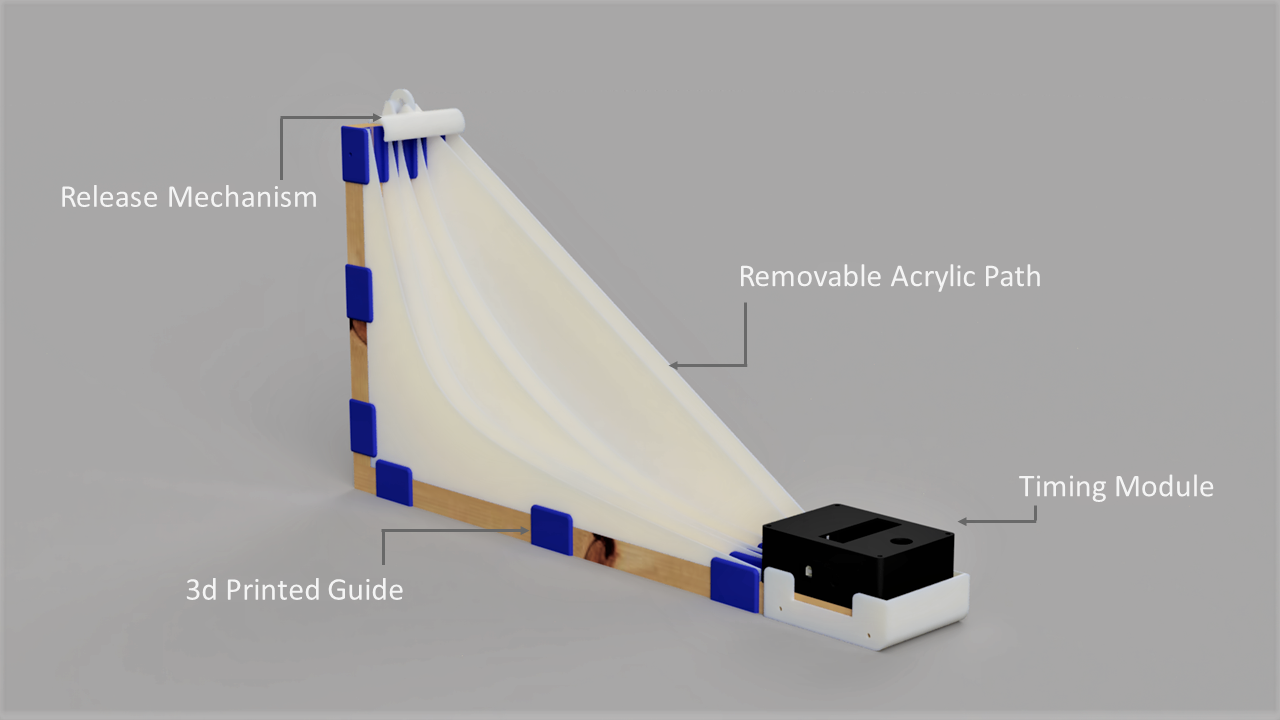
We designed the brachistochrone curve on Fusion360 along with 2 other curves, one that was steeper and the other just a straight line. We created mounting pieces for the curves that allowed us to interchange curves if required. The pieces were fabricated using a 3D printer and laser cutter. The frame was built out of 1x3 inch planks of wood. The timing module consists of 3 limit switches, an arduino uno, an lcd screen and a push button. The push button starts the timer, and the individual limit switches stop the respective timers when the marble knocks into it. The timings are then displayed onto the lcd screen.
Conclusion
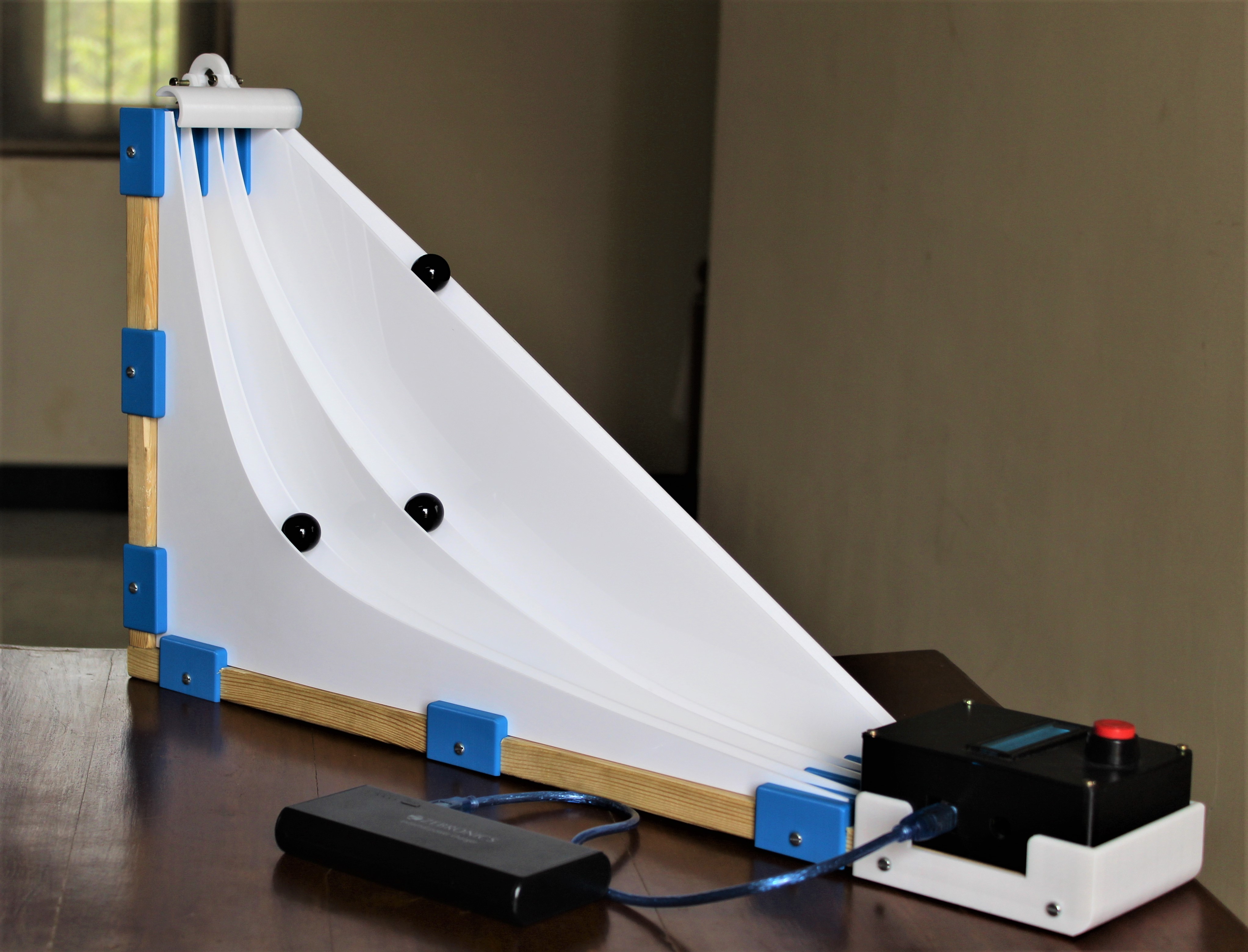
Once we completed the build, we tested the apparatus in a classroom. The timing module verifies the math and the marble that rolls down the brachistochrone curve is the fastest, followed by the steepest curve and finally the straight line path. The students and teacher enjoyed the experiment and we received great feedback for it.